Dorrigo Evans’s Inability to Remember the Faces of the Dead
The Narrow Road to the Deep NorthDorrigo Evans’s inability to remember the faces of the dead gives a personal shape to the novel’s larger struggle over wartime memory: the men he cannot picture are also among those whom public accounts and memorials fail to name. He tries to write about the Death Railway and its dead, yet his own face has become widely recognizable while the faces of the men he wishes to honor remain beyond his reach. His failure is not presented as a simple absence of memory. Words, images, objects, and remembered acts persist, but they do not restore the people themselves.
The Missing Faces
At seventy-seven, Dorrigo reflects on how his conduct and choices have shaped his life, including his work in the camps and his relationships after the war. In the same period, he recognizes that his public presence has come to eclipse the people he wants remembered: his face is everywhere, while he can no longer see theirs. He hopes that writing about the dead, rather than about himself, might correct that imbalance. Even humility gives him pause, because he fears that presenting himself as self-effacing could further enhance his reputation. The effort to remember others is therefore entangled with an uncomfortable awareness of his own fame.
The problem becomes intimate when Dorrigo is asked about Darky Gardiner. He can identify him by name, but cannot summon his face. The difference between remembering a name and seeing a person is central to the pain of the moment: Darky’s death remains emotionally consequential, yet Dorrigo cannot call back the features that would make him present in memory. He thinks that Darky’s death had no point and wonders why he cannot write that simple truth or see Darky’s face. The inability is not merely a gap in a catalogue of facts; it obstructs both mourning and the act of giving testimony.
The Sky and the Attempt to Bear Witness
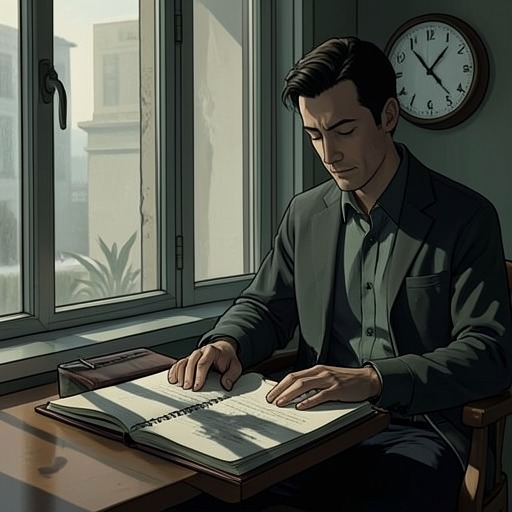
Dorrigo is asked to write a foreword to a book of sketches and illustrations by Guy Hendricks, a prisoner who died on the Line. During the war, Dorrigo carried and hid Guy Hendricks's Sketchbook. Years later, the task of writing about the drawings brings him back to the Death Railway and to the memory of Darky, whom he had not thought about for years until he tried to write an account of his beating. The foreword is already overdue when he sets aside three uninterrupted hours to finish it, and even its completion feels to him like another failed attempt to understand what the railway meant.
When Dorrigo tries to remember Darky, what returns instead is the sky during the Speedo: dirty, bruised in appearance, and seemingly racing away from the suffering below. Darky’s face, singing, and split smile remain desired images, but the sky takes their place. This substitution shows how recollection can preserve the conditions surrounding a person without recovering the person himself. Dorrigo also recalls Darky’s idea that every throw is always the first. The thought survives as a distinct piece of speech and offers a way of thinking about chance, but it does not restore Darky’s face. Memory retains fragments; it does not necessarily reunite them into a complete presence.
Private Memory and Public Commemoration
The difficulty of remembering individuals is set against the commemoration of the Death Railway. On 25 October 1943, steam locomotive C 5631 travelled the completed railway with Japanese and Thai dignitaries aboard its carriages. The locomotive is later displayed at Yasukuni Shrine in Tokyo, alongside the Book of Souls, which records more than two million people who died in service to the Emperor of Japan between 1867 and 1951. The shrine’s commemorative meaning includes absolution, while the names of executed war criminals, some convicted of mistreating prisoners on the railway, are also included in the register.
The plaque in front of C 5631 does not mention the horror of the railway’s construction or the people who died building it. The number of dead is not settled: Allied prisoners were only part of the labor force, which also included hundreds of thousands of Asian laborers, and estimates for their deaths vary widely. The novel insists that no one knows the total and that the laborers’ names have already been forgotten. Dorrigo’s inability to summon a face thus meets a larger erasure: whole groups of dead people have no names in the memorial display and no agreed count. His foreword cannot repair that loss, but his wish to direct attention away from himself toward the forgotten makes the act of writing a form of attempted correction.
Objects, Rituals, and the Limits of Remembrance
A stark instance of the conflict between remembering and surviving occurs after Rabbit Hendricks dies of cholera. Because possessions associated with the disease must be burned, a pyre maker brings Dorrigo Rabbit Hendricks's Sketchbook. Dorrigo tells him to burn it and waves it away. The scene places the preservation of a record against the immediate rules of the camp: the sketchbook has carried images across the war, but in this moment it is treated as something that cannot be kept. Dorrigo’s action does not erase the wider significance of the drawings or his earlier efforts to protect them; it shows that remembrance takes place under material pressures that can make preservation impossible.
Later, Bonox Baker challenges Dorrigo’s insistence that everything is eventually forgotten and that the living are better served by living now. Bonox invokes the public appeal not to forget. Their exchange leaves the tension unresolved: Dorrigo speaks from the knowledge that memory fades, while Bonox holds to remembrance as a duty. Neither position can return the dead, and the scene does not make forgetting equivalent to indifference. Instead, it shows how the survivors negotiate what can be borne, what must be remembered, and what no individual can preserve indefinitely.
Memory’s Uneven Afterlife
Jimmy Bigelow’s later recollections offer a related but distinct picture of what survives. He remembers fragments such as jokes, stories, the taste of a duck egg given to him by Darky, hope, and goodness. He remembers Wat Cooney’s habit of waiting at the cookhouse so that the last man would still receive food, and the reluctance of the men to be the first to cast earth onto Wat’s grave. Yet Jimmy does not remember the circumstances of Wat’s death on the march north to Three Pagoda Pass or the cruelties of that march. His sons and others increasingly correct his accounts, but their corrections do not make his selective memories disappear.
This contrast clarifies the form of Dorrigo’s loss without equating the two men’s memories. Jimmy retains gestures of care and fragments of fellowship while losing parts of the surrounding history. Dorrigo, by contrast, can describe the railway, its violence, and the failures of its commemoration, yet cannot recover the faces of the men he wishes to honor. Across these different forms of remembering, the novel separates factual knowledge from the felt presence of the dead. Dorrigo’s inability remains unresolved: the names, images, words, and obligations endure, but they cannot make the lost faces visible again.